Monday, October 8, 2012

Dr. No

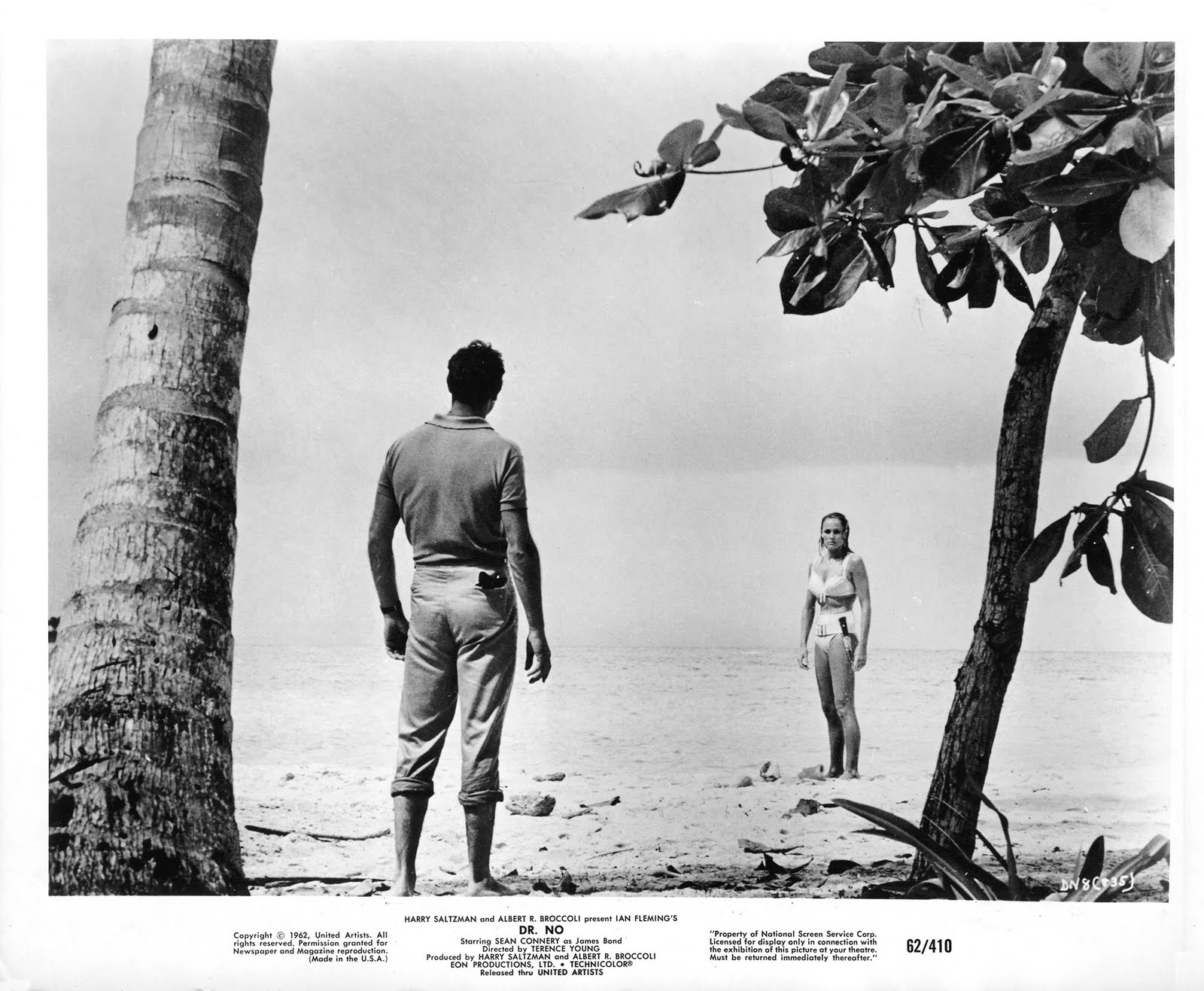
Bond: “I promise I won't steal your shells.”
Honey: “I promise you you won't, either. Stay where you are!”
Bond: “I can assure you, my intentions are strictly honorable.”

Dr. No: “SPECTRE. Special Executive for Counterintelligence, Revenge and Extortion. The four great cornerstones of power, headed by the greatest brains in the world.”
Bond: “Correction, criminal brains.”
Dr. No: “The successful criminal brain is always superior. It has to be.”

Bond: “I admire your courage Miss..?”
Silvia: “Trench. Silvia Trench. I admire your luck Mr?”
Bond: “Bond. James Bond.”


On October 3, 2012, Reel FX began a James Bond Festival to celebrate the 50th Anniversary of the series.  We will screen all 22 official James Bond films and the 2 unofficial Bond films, in chronological order, beginning with:


Dr. No


Dr. No is a 1962 spy film, starring Sean Connery; it is the first James Bond film. Based on the 1958 Ian Fleming novel of the same name, it was adapted by Richard Maibaum, Johanna Harwood, and Berkely Mather and was directed by Terence Young. The film was produced by Harry Saltzman  and Albert R. Broccoli, a partnership that would continue until 1975.

In the film, James Bond is sent to Jamaica to investigate the death of a fellow British agent. The trail leads him to the underground base of Dr. Julius No, who is plotting to disrupt an early American manned space launch with a radio beam weapon. Although the first of the Bond books to be made into a film, Dr. No was not the first of Fleming's novels, Casino Royale being the debut for the character; however, the film makes a few references to threads from earlier books.


Dr. No was produced with a low budget, but was a financial success. While critical reaction at release was mixed, over time the film received a reputation as one of the franchise's best installments. The film was the first of a successful series of 22 Bond films; a 23rd is planned for release in 2012. Dr. No also launched a genre of "secret agent" films that flourished in the 1960s. The film also spawned a spin-off comic book and soundtrack album as part of its promotion and marketing.

Many of the iconic aspects of a typical James Bond film were established in Dr. No: the film begins with an introduction to the character through the view of a gun barrel and a highly stylized main title sequence, both created by Maurice Binder. Production designer, Ken Adam, established an elaborate visual style that is one of the hallmarks of the Bond film series.

 Production:


When Harry Saltzman gained the rights for the James Bond book, he initially did not go through with the project. Instead, Albert R. 'Cubby' Broccoli wanted the rights to the Bond books and attempted to buy them from Saltzman. Saltzman did not want to sell the rights to Broccoli and instead they formed a partnership to make the James Bond films. A number of Hollywood film studios did not want to fund the films, finding them "too British" or "too blatantly sexual". Eventually the two received authorization from United Artists to produce Dr. No, to be released in 1962. Saltzman and Broccoli created two companies: Danjaq, which was to hold the rights to the films, and Eon Productions, which was to produce them. The partnership between Broccoli and Saltzman lasted until 1975, when tensions during the filming of The Man with the Golden Gun led to an acrimonious split and Saltzman sold his shares of Danjaq to United Artists. 


Initially Broccoli and Saltzman had wanted to produce Thunderball as the first film, but there was an ongoing legal dispute between the screenplay's co-author, Kevin McClory and Ian Fleming. As a result Broccoli and Saltzman chose Dr. No: the timing was apposite, with claims that American rocket testing at Cape Canaveral had problems with rockets going astray.

The producers offered Dr. No to Guy Green, Guy Hamilton, Val Guest and Ken Hughes to direct, but all of them turned it down. They finally signed Terence Young who had a long background with Broccoli's Warwick Films as the director. Broccoli and Saltzman felt that Young would be able make a real impression of James Bond and transfer the essence of the character from book to film. Young imposed many stylistic choices for the character which continued throughout the film series. Young also decided to inject much humor, as he considered that "a lot of things in this film, the sex and violence and so on, if played straight, a) would be objectionable, and b) we're never gonna go past along the censors; but the moment you take the mickey out, put the tongue out in the cheek, it seems to disarm."


The producers asked United Artists for financing, but the studio would only put up $1 million. Later, the UK arm of United Artists provided an extra $100,000 to create the climax where Dr. No's base explodes. As a result of the low budget, only one sound editor was hired (normally there are two, for sound effects and dialogue), and many pieces of scenery were made in cheaper ways, with M's office featuring cardboard paintings and a door covered in a leather-like plastic, the room where Dent meets Dr. No costing only £745 to build, and the aquarium in Dr. No's base being magnified stock footage of goldfish. Furthermore, when art director Syd Cain found out his name was not in the credits, Broccoli gave him a golden pen to compensate, saying that he did not want to spend money making the credits again.


Writing:


Broccoli had originally hired Richard Maibaum and his friend Wolf Mankowitz to write Dr. No's screenplay, partly because of Mankowitz’s help in brokering the deal between Broccoli and Saltzman. An initial draft of the screenplay was rejected because the scriptwriters had made the villain, Dr. No, a monkey.  Mankowitz left the movie, and Maibaum then undertook a second version, more closely in line with the novel. Johanna Harwood and Berkely Mather then worked on Maibaum's script, with Harwood in particular being described as a script doctor who helped put elements more in tune with a British character. Mankowitz eventually had his name removed from the credits after viewing early rushes, as he feared it would be a disaster.


During the series' forty-year history only a few of the films have remained substantially true to their source material; Dr. No has many similarities to the novel and follows its basic plot, but there are a few notable omissions. Major elements from the novel that are missing from the film include Bond's fight with a giant squid, and the escape from Dr. No's complex using the dragon-disguised swamp buggy. Elements of the novel that were significantly changed for the film include the use of a (non-poisonous) tarantula spider instead of a centipede; Dr. No's secret complex being disguised as a bauxite mine instead of a guano quarry; Dr. No's plot to disrupt NASA space launches from Cape Canaveral using a radio beam instead of disrupting US missile testing on Turk's Island; the method of Dr. No's death by drowning in reactor coolant rather than a burial under a chute of guano, and the introduction of SPECTRE, an organization absent from the book. Components absent from the novel but added to the film include the introduction of the Bond character in a gambling casino, the introduction of Bond's semi-regular girlfriend Sylvia Trench, a fight scene with an enemy chauffeur, a fight scene to introduce Quarrel, the seduction of Miss Taro, Bond's recurring CIA ally Felix Leiter, Dr. No's partner in crime Professor Dent and Bond's controversial cold-blooded killing of this character.

Sometimes episodes in the novel retained in the film's altered narrative introduce elements of absurdity into the plot. Bond's "escape" from his cell via the air shaft, for instance, originally conceived as a ruse of Dr. No's to test Bond's skill and endurance, becomes an authentic break-out in the film. Features carried over from the novel's obstacle course, however, such as the torrent of water and scalding surface, have no logical justification in the script. Such incongruities would recur in subsequent Bond films.

Casting:

Artist rendering of James Bond, commissioned by Ian Fleming


While producers Broccoli and Saltzman originally sought Cary Grant for the role, they discarded the idea as Grant would be committed to only one feature film, and the producers decided to go after someone who could be part of a franchise. Richard Johnson has claimed to have been the first choice of the director, but he turned it down because he already had a contract with MGM and was intending to leave. Another actor purported to have been considered for the role was Patrick McGoohan on the strength of his portrayal of spy John Drake in the television series Danger Man: McGoohan turned down the role. Another potential Bond included David Niven, who would later play the character in the 1967 satire Casino Royale.


There are several apocryphal stories as to whom Ian Fleming personally wanted. Reportedly, Fleming favored actor Richard Todd. In his autobiography When the Snow Melts, Cubby Broccoli said Roger Moore had been considered, but had been thought "...too young, perhaps a shade too pretty." In his autobiography, My Word Is My Bond, Moore says he was never approached to play the role of Bond until 1973, for Live and Let Die. Moore appeared as Simon Templar on the television series The Saint, airing in the United Kingdom for the first time on 4 October 1962, only one day before the premiere of Dr. No.

Ultimately, the producers turned to 30-year-old Sean Connery for five films. It is often reported that Connery won the role through a contest set up to "find James Bond". While this is untrue, the contest itself did exist, and six finalists were chosen and screen tested by Broccoli, Saltzman, and Fleming. The winner of the contest was a 28 year-old model named Peter Anthony, who, according to Broccoli, had a Gregory Peck quality, but proved unable to cope with the role. When Connery was invited to meet Broccoli and Saltzman he appeared scruffy and in unpressed clothes, but Connery "put on an act and it paid off" as he acted in the meeting with a macho, devil-may-care attitude. When he left both Saltzman and Broccoli watched him through the window as he went to his car, both agreeing that he was the right man for Bond. After Connery was chosen, Terence Young took the actor to his tailor and hairdresser, and introduced him to the high life, restaurants, casinos and women of London. In the words of Bond writer Raymond Benson, Young educated the actor "in the ways of being dapper, witty, and above all, cool".


 Secondary Cast:


For the first Bond girl Honey Ryder, Julie Christie was considered, but discarded as the producers felt she was not voluptuous enough. Just two weeks before filming began, Ursula Andress was chosen to play Honey after the producers saw a picture of her taken by Andress' then-husband John Derek (later, Bo Derek’s husband). To appear more convincing as a Jamaican, Andress had a tan painted on her and ultimately had her voice dubbed over due to her heavy Swiss German accent.


For Bond's antagonist Dr. Julius No, Ian Fleming wanted his friend Noël Coward, and he answered the invitation with "No! No! No!" Harry Saltzman picked Joseph Wiseman because of his performance in the 1951 film Detective Story, and the actor had special make-up applied to invoke No's Chinese heritage.  


The role as the first Felix Leiter was given to Jack Lord (Hawaii Five-0). This is Bond and Leiter's first time meeting each other on film and Leiter does not appear in the novel. Leiter returns for many of Bond's future adventures and in the 2006 reboot of the film series, Casino Royale, Leiter and Bond are seen meeting one another again for the first time. This was Lord's only appearance as Leiter, as he asked for more money and a better billing to return as Leiter in Goldfinger and was subsequently replaced.

The cast also included a number of actors who were to become stalwarts of the future films, including Bernard Lee, who played Bond's superior M for another ten films, and Lois Maxwell, who played M's secretary Moneypenny in fourteen instalments of the series. Lee was chosen because of being a "prototypical father figure", and Maxwell after Fleming thought she was the perfect fit for his description of the character. Maxwell was initially offered a choice between the roles of Moneypenny or Sylvia Trench and opted for Moneypenny as she thought the Trench role, which included appearing in immodest dress, was too sexual. Eunice Gayson was cast as Sylvia Trench and it was planned that she would be a recurring girlfriend for Bond throughout six films, although she only appeared in Dr. No and From Russia with Love. She had been given the part by director Terence Young, who had worked with her in Zarak and invited Gayson saying "You always bring me luck in my films", although she was also cast due to her voluptuous figure. One role which was not given to a future regular was that of Major Boothroyd, the head of Q-Branch, which was given to Peter Burton. Burton was unavailable for the subsequent film, From Russia with Love, and the role was taken by Desmond Llewelyn.

  
Anthony Dawson, who played Professor Dent, met director Terence Young when he was working as a stage actor in London, but by the time of the film's shooting Dawson was working as a pilot and crop duster in Jamaica. Dawson also portrayed Ernst Stavro Blofeld, head of SPECTRE, in From Russia with Love and Thunderball, although his face was never seen and his voice was dubbed by Eric Pohlmann. Zena Marshall, who played Miss Taro, was mostly attracted by the humorous elements of the script, and described her role as "this attractive little siren, and at the same time I was the spy, a bad woman", who Young asked to play "not as Chinese, but a Mid-Atlantic woman who men dream about but is not real". The role of Taro was previously rejected by Marguerite LeWars, the Miss Jamaica 1961 who worked at the Kingston airport, as it required being "wrapped in a towel, lying in a bed, kissing a strange man". LeWars appeared as a photographer hired by Dr. No instead.

The Introduction of James Bond:


The character James Bond was introduced towards, but not at, the beginning of the film in a "now-famous nightclub sequence featuring Sylvia Trench", to whom he makes his "immortal introduction". The introduction to the character in Le Cercle at Les Ambassadeurs, an upscale gambling club, is derived from Bond's introduction in the first novel, Casino Royale which Fleming had used because "skill at gambling and knowledge of how to behave in a casino were seen...as attributes of a gentleman". After losing a hand of Chemin de Fer to Bond, Trench asks his name. There is the "most important gesture [in]...the way he lights his cigarette before giving her the satisfaction of an answer. 'Bond, James Bond'." Once Connery says his line, Monty Norman's Bond theme plays "and creates an indelible link between music and character." In the short scene introducing Bond, there are portrayed "qualities of strength, action, reaction, violence – and this elegant, slightly brutal gambler with the quizzical sneer we see before us who answers a woman when he's good and ready." Raymond Benson, author of the continuation Bond novels, has stated that as the music fades up on the scene, "we have ourselves a piece of classic cinema".  


Following the release of Dr. No, the quote "Bond ... James Bond," became a catch phrase that entered the lexicon of Western popular culture: writers Cork and Scivally said of the introduction in Dr. No that the "signature introduction would become the most famous and loved film line ever". In 2001 it was voted as the "best-loved one-liner in cinema" by British cinema goers. In 2005, it was honored as the 22nd greatest quotation in cinema history by the American Film Institute as part of their 100 Years Series.


Soundtrack:


Monty Norman was invited to write the soundtrack because Broccoli liked his work on the 1961 theatre production Belle, a musical about murderer Hawley Harvey Crippen. Norman was busy with musicals, and only accepted to do the music for Dr. No after Saltzman allowed him to travel along with the crew to Jamaica. The most famous composition in the soundtrack is the "James Bond Theme", which is heard in the gun barrel sequence and in a calypso medley over the title credits, and was written by Norman based on a previous composition of his. John Barry, who would later go on to compose the music for eleven Bond films, arranged the Bond theme, but was uncredited—except for the credit of his orchestra playing the final piece. It has occasionally been suggested that Barry, not Norman, composed the "James Bond Theme". This argument has been the subject of two court cases, the most recent in 2001, which found in favor of Norman. The theme, as written by Norman and arranged by Barry, was described by another Bond film composer, David Arnold, as "bebop-swing vibe coupled with that vicious, dark, distorted electric guitar, definitely an instrument of rock 'n' roll...it represented everything about the character you would want: It was cocky, swaggering, confident, dark, dangerous, suggestive, sexy, unstoppable. And he did it in two minutes."


Themes:


Dr. No introduced the many recurring themes and features associated with the suave and sophisticated secret agent: the distinctive "James Bond Theme", the gun barrel sequence, his initial mission briefing with M, "Bond girls", the criminal organisation SPECTRE, narrow escapes, Bond's luck and skill, his signature Walther PPK and the license to kill, over-ambitious villains, henchmen and allies. Many characteristics of the following Bond films were introduced in Dr. No, ranging from Bond's introduction as "Bond, James Bond" (although he seems to be mimicking Sylvia Trench who introduces herself first as "Trench. Sylvia Trench"), to his taste for vodka martinis "shaken, not stirred", love interests, and weaponry.


Dr. No also establishes the oft-repeated association (in this case, Project Mercury) between the Bond series and the US manned space program—which would be repeated with Project Gemini in You Only Live Twice, Project Apollo in Diamonds Are Forever, and the space shuttle in Moonraker (not to mention several outer space sequences involving fictional satellite programs in GoldenEye, Tomorrow Never Dies, and Die Another Day.


Ian Fleming Novels:


Whilst serving in the Naval Intelligence Division, Ian Fleming had planned to become an author and had told a friend, "I am going to write the spy story to end all spy stories." On 17 February 1952, he began writing his first James Bond novel, Casino Royale at his Goldeneye estate in Jamaica, where he wrote all his Bond novels, during the months of January and February each year. He started the story shortly before his wedding to his pregnant girlfriend, Ann Charteris, in order to distract himself from his forthcoming nuptials.  


Ian Fleming's Goldeneye estate
After completing the manuscript for Casino Royale, Fleming showed the manuscript to his friend (and later editor) William Plomer to read. Plomer liked it and submitted it to the publishers, Jonathan Cape, who did not like it as much. Cape finally published it in 1953 on the recommendation of Fleming's older brother Peter, an established travel writer. Between 1953 and 1966, two years after his death, twelve novels and two short-story collections were published, with the last two books – The Man with the Golden Gun and Octopussy and The Living Daylights – published posthumously. All the books were published in the UK through Jonathan Cape.


  • 1953 Casino Royale
  • 1954 Live and Let Die
  • 1955 Moonraker
  • 1956 Diamonds Are Forever
  • 1957 From Russia, with Love
  • 1958 Dr. No
  • 1960 For Your Eyes Only (short stories)
  • 1961 Thunderball
  • 1962 The Spy Who Loved Me
  • 1963 On Her Majesty's Secret Service
  • 1964 You Only Live Twice
  • 1965 The Man with the Golden Gun
  • 1966 Octopussy and The Living Daylights (short stories) 

 
Dr. No was directed by Terence Young and written by Richard Maibaum, Berkely Mather and Johanna Harwood, based on a novel by Ian Fleming.
Rated PG, 110 min, Mono, 1.37:1 Aspect Ratio.


Wednesday, August 22, 2012

Restrepo

“An often electrifying verite’ trip into combat and the hearts of men.” -Variety

“An unprecedented work of art.” - New York Magazine


The Film & Art Study continued the Documentary Series on Aug 1, 2012, with a discussion of the Documentary art form in “cinema verite’ style and a presentation of the (2010) American film, RESTREPO, by directors, Tim Hetherington and Sebastian Junger.         


From Tim Kelly, President of National Geographic Society:

National Geographic is devastated by the tragic news of Tim Hetherington's death in Libya. This is a sad and terrible day. We join the community of dedicated photojournalists and documentarians around the world who are mourning his loss.

IN MEMORIAM

Tim Hetherington
1970-2011
  

Hetherington & Junger at OP RESTREPO
 

RESTREPO


Restrepo explores the year that Junger and Hetherington spent in Afghanistan on assignment for Vanity Fair , embedded with the Second Platoon, B Company, 2nd Battalion, 503rd Infantry Regiment (airborne), 173rd Airborne Brigade Combat Team of the U.S. Army in the Korengal Valley. The 2nd Platoon is depicted defending an Observation Post (OP) named OP Restrepo.

The film follows the 2nd Platoon of Battle Company on a 15-month deployment in the Korengal Valley of northeast Afghanistan  in the Nuristan area. The Korengal flows north to the Pech, which then flows east to the Kunar River valley on the border with Pakistan. The film chronicles the lives of the men from their deployment to the time of their return home. The Korengal Valley was at the time regarded as "the deadliest place on Earth" (as stated in the documentary itself, trailers, and television commercials on the National Geographic Channel). The goal of the deployment was to clear the Korengal Valley of insurgency and gain the trust of the local populace.


OP: RESTREPO

Recording Combat, Boredom, Terror


Starting in June 2007, Tim Hetherington and Sebastian Junger dug in with the men of Second Platoon, making a total of ten trips to the Korengal on assignment for Vanity Fair magazine and ABC News. Each trip started with a helicopter flight into the main firebase in the valley and then a two-hour foot patrol out to Restrepo. There was no running water at Restrepo, no Internet, no phone communication, and for a while, there was no electricity or heat—it was essentially just sandbags and ammo. Some days the outpost was attacked three or four times from distances as close as 50 yards.


Hetherington and Junger—sometimes working together, sometimes alone—did everything the soldiers did except pull guard duty and shoot back during firefights. They slept alongside the soldiers, ate with them, survived the boredom and the heat and the cold and the flies with them, went on patrol with them, and eventually came to be considered virtually part of the platoon. By the end of the deployment, they had shot a total of 150 hours of combat, boredom, humor, terror, and daily life at the outpost.


Conditions for filmmaking couldn’t have been harsher. The surrounding mountains rose to a height of 10,000 feet—which was traversed on foot. Long operations meant carrying enough camera batteries to last a week or more, on top of the 50 or so pounds of gear required on even ordinary patrols. Cameras got smashed into rocks, clogged with dirt, and hit with shell cartridges during firefights.  

40 mm Grenades in Bandoleer

Men were killed and wounded during filming, so there was a constant issue of when it was OK to turn on the cameras and when it was not. Only the filmmakers’ close relationships with the men of the platoon allowed them to keep shooting in situations where other journalists might have been told to stop.
Three months after the end of the deployment, Hetherington and Junger traveled to Vicenza, Italy, where the unit is based. They used two VariCams, a full light and sound package, and two cameramen to conduct in-depth interviews with their main characters.


These interviews—initially considered a kind of glue for the verité and a way to avoid outside narration—wound up being some of the most powerful and affecting material of the entire project. The soldiers were able to allow themselves a level of emotion and introspection that is simply not possible in combat.  


Interview With Sebastian Junger & Tim Hetherington 


How did you come across this particular assignment? What brought you there? Why did it appeal to you?

Sebastian Junger: We were on assignment for Vanity Fair and ABC News. After an embed with Battle Company in 2005, I’d had the idea of following one platoon for an entire deployment and both writing a book and making a documentary about their experience.

We hear the initial reactions of the soldiers upon learning that they’ve been assigned to the Korengal Valley. What was your first impression of Korengal?
SJ:
When I stepped off the helicopter in June ’07 I was stunned by the ruggedness of the terrain—and the beauty. Then again, I didn’t have to spend a year there, and I assumed the fighting would be minimal, which of course it wasn’t.

What kind of advice or protection did the soldiers offer you while you were shooting? Did you receive any training or safety guidelines prior to shipping out?
SJ:
They knew Tim and I had been in plenty of wars before this, so they didn’t really offer any advice. Once or twice during combat I was advised where good cover was (it depends on what direction they’re shooting from).

Did you take turns with the camera?
Tim Hetherington:
We each had a camera and filmed more or less of our own volition. If I was busy taking stills, Sebastian would make sure to cover the camerawork. There were scenes where we were both shooting, and we would divide things up in a crude manner—I’d take the wides, he’d take the tights, or I’d shoot the Afghans while he shot the Americans.

What limits were placed on your access?
TH:
No limits at all on access—none. There was a stated agreement that we would not shoot wounded American soldiers—or would get their OK later—and I think there was an understanding that we would be very sensitive about filming the dead. The Army asks to review a rough cut later for security and privacy concerns, but they had no issues.


Did you stay the entire duration of their deployment?
TH
: No, we did five trips each, sometimes together, sometimes not. Each trip lasted around a month.

How much footage was shot? Did you ship footage back as you went along?
SJ
: We shot 150 hours of footage, and we’d bring our footage back on each trip and copy it and log it. We also shot around 40 hours of interviews at the soldiers’ base in Italy about three months after the deployment.

Who are these soldiers? Did you get any distinct impressions of them, where they came from, why they were there?
TH:
No one had followed a platoon for an entire duration of [its] deployment, so we became incredibly close to many of the soldiers. They came from a variety of backgrounds and had joined the Army for a myriad of competing reasons. Some said they needed to get out of their parents’ home and saw the Army as offering them independence; others [said] that they were seeking a rite of passage and new experiences. Many didn't think they had many options open to them and saw the Army as the best opportunity on offer. They came from all over the U.S.—many from Texas and California, others from faraway places like Guam.

What kind of dynamic did you have with your subjects?
SJ:
Each trip the dynamic got more and more relaxed and comfortable. It became clear to the soldiers that we were not doing a political story and that we were comfortable in that environment—and that we were willing to take the same risks they were and endure the same discomforts. Tim broke his leg in combat; I ripped my Achilles tendon. Then I got blown up, but none of those things kept us from going back out there.

After being under fire for a sustained period, how would you describe the effect it has on you? Did you notice any change in the soldiers over the course of your time with them?
SJ:
Both of us have been war reporters for some time now, so this was not our first experience being shot at. Being in a combat zone can be both exhilarating and terrifying, combined with long stretches of boredom. Things appear very simple in a war zone as the clutter of daily living recedes with the larger equation of being killed or staying alive. Mix this with being drip-fed adrenalin, and inevitably it's going to make “coming back” incredibly difficult. I think this is something that the soldiers experienced, and to a lesser extent we also.

In one scene, we see a soldier making small talk during serious acts of war. It’s quite affecting. Why did you choose to include it? Were there other moments like this that struck you?
TH:
There's a great emphasis in war reporting on capturing the actual “bang-bang” fighting of war—and many reporters feel that any work would be incomplete without a sense of this “action.” We were no different, but because there was an incredible amount of fighting going on in the Korengal Valley, recording the actual firefights got quite boring. What was infinitely more interesting and revealing was how the soldiers carried on in these situations. People who haven't experienced war inevitably base their understanding of it [on] the mediated versions of news or Hollywood. These representations are often limited and can't quite reveal the humor, boredom, and confusion inherent in combat. It's something we felt was important to represent.

The film shows how multifaceted the role of the captain is with respect to his team and the village—being able not only to advance the military goal but also having to communicate the humanitarian aspects too. Were there any dynamics that you hadn’t anticipated that you were especially glad to have captured?
SJ:
I was unprepared for just how smart and dedicated the officers were, and many of the enlisted men as well. I was also amazed by how open and welcoming they were with us, the press. It was not what I had anticipated.

Were there any interactions with the village people or elders that you wish you could have included in the film?
TH:
There were many, many scenes of all types that we were heartbroken not to include in the film. There were very funny moments in the shuras—the meetings with the elders—and also very intense moments when someone was very angry. There were several scenes of locals saying how much they hated the Taliban and gave up information on them, and other scenes where they clearly hated the Americans and wanted them to leave. All of it shows the complexity of this kind of war, but we couldn’t put everything into the movie.

The film is very balanced and doesn’t lead the viewer but rather shows it how it is. Did you have any guiding principles about how and what you shot as well as how you edited and shaped the film ultimately?
SJ:
We were not interested in the political dimensions of the war, only the experience of the soldiers, so we limited ourselves to the things soldiers had access to. We did not ask any generals why they were in the Korengal, for example, because soldiers don’t have that opportunity, either. Our guiding principle was that we would only have people in the movie who were fighting in the Korengal. It was that principle that excluded Tim and me from the movie as well … and prevented us from using an outside narrator.
TH: It was a conscious choice. We are journalists, and as such, we are not supposed to “lead” people to a certain opinion. That is called advocacy, and it certainly has its special place in the media world, but as journalists, it’s not something we wanted to engage in.


Reception


Restrepo received the Grand Jury Prize for best documentary at the 2010 Sundance Film Festival. It received a certified fresh rating of 96% on Rotten Tomatoes. Roger Ebert awarded Restrepo four out of four stars.  Additionally, numerous critics and publications included it in their annual top film selections.


Restrepo
was named as one of the top documentary films of 2010 by the National Board of Review.

It was nominated for the 2011 Academy Award for Best Documentary which was won by Inside Job.

Restrepo was directed by Tim Hetherington and Sebastian Junger.
Rated R, 93 min, Dolby Digital, 1.78:1 Aspect Ratio.


INFANTRY TYPES 

The US Army has several variants of Infantryman. They are distinguished by the weapons they use or the way they are inserted into the battlefield. The job classification for Infantryman (or foot soldier) in the US Army is referred to as 11B (Bravo).

11B - Infantry

Light Infantry
Light Infantry:


Today the term "light" denotes, in the United States table of organization and equipment, units lacking heavy weapons and armor or with a reduced vehicle footprint. Light infantry units lack the lethality, tactical mobility and survivability of heavy units, but possess greater operational mobility and the ability to execute missions under restrictive terrain and weather that may otherwise impair a heavy unit's mobility. Light infantry forces typically rely on their ability to operate under restrictive conditions, surprise, violence of action, training, stealth, field craft, and fitness level of the individual soldier to address their reduced lethality. Ironically, forces in a light unit will normally carry heavier individual loads versus other forces; they must carry everything they require to fight, survive and win due to lack of vehicles. Although units like the 101st Airborne (Air Assault) and the 82nd Airborne Division are categorized as Air Assault Infantry and Airborne Infantry respectively, they fall under the overall concept of light infantry.


Indirect Fire Infantry


Infantry Mortarman (Indirect Fire Infantry - 11C):


Mortarmen are responsible for the tactical employment of the 60mm light mortar and the 81mm medium mortar. Mortarmen provide indirect fire in support of the rifle and LARS (Light Armored Reconnaissance Squad) quads/platoons/companies and the infantry and LAR battalions. They are located in the weapons platoons of the rifle and LAR companies and the weapons company of the infantry battalion. Noncommissioned officers are assigned as mortar gunners, forward observers, fire direction plotters, and squad and section leaders.


Heavy Anti-Armor Infantry

Heavy Anti-Armor Weapons Infantryman (11H):

A Heavy Anti-Armor Weapons Infantryman operates weapons and equipment in ground combat operations while deploying in an uparmored HMMWV (Humvee). Duties include operating and maintaining weapons, such as TOW Missile system, rifles, machine guns, mortars, and hand grenades; locating, constructing, and camouflaging infantry positions and equipment; evaluating terrain and recording topographical information; operating and maintaining field communications equipment; assessing need for and directing supporting fire; placing explosives and performing minesweeping activities on land; and participating in basic reconnaissance operations.  

Mechanized Infantry


Mechanized Infantryman (11M):

The fighting vehicle infantryman leads, supervises, and serves as a member of a fighting vehicle unit or activity employing vehicular and dismounted weapons in combat operations. Duties for MOS 11M at each level of skill are: 

Skill Level 1. Performs duties as IFV (Infantry Fighting Vehicle) driver, gunner, or fire team member. Operates both mounted and dismounted to close with and destroy the enemy. Employs, operates, and maintains assigued weapons and equipment. Employs proper dismounted movement techniques, cover, concealment, and camouflage as part of dismount team. Performs basic communication functions and operates platoon communications equipment. Constructs individual fighting positions. Assists in the construction of fortification and barriers, including minefields and obstacles. Assist in the breaching of minefields and obstacles. Collects and reports tactical information as member of combat or reconnaissance patrol. Operates IFV over varied terrain in varied visibility. Conducts preventive maintenance checks and serv ices on the IFV and its components. Assists in target detection, identification, and round sensing. 

Airborne Infantry

Airborne Infantry (11B-Airborne):

Airborne forces are military units, usually light infantry, set up to be moved by aircraft and "dropped" into battle. Thus they can be placed behind enemy lines, and have the capability to deploy almost anywhere with little warning. The formations are limited only by the number and size of their aircraft, so given enough capacity a huge force can appear "out of nowhere" in minutes, an action referred to as vertical envelopment.

Conversely, airborne forces typically lack the supplies and equipment for prolonged combat operations, and are therefore more suited for airhead operations than long-term occupation; furthermore, parachute operations are particularly sensitive to adverse weather conditions. Advances in helicopter technology since World War II have brought increased flexibility to the scope of airborne operations, and Air Assaults have largely replaced large-scale parachute operations, and (almost) completely replaced combat glider operations. However, due to the limited range of helicopters and the limited number of troops that can be transported by them many countries retain Paratroopers as a valuable strategic asset.

Air Assault Infantry

Air Assault Infantry (11B-Air Assault):

Air assault is the movement of ground-based military forces by vertical take-off and landing(VTOL) aircraft—such as the helicopter—to seize and hold key terrain which has not been fully secured, and to directly engage enemy forces.  In addition to regular infantry training, air-assault units usually receive training in rappelling and air transportation, and their equipment is sometimes designed or field-modified to allow better transportation within aircraft.

Due to the transport load restrictions of helicopters, air assault forces are usually light infantry, though some armored fighting vehicles, like the Russian BMD-1 are designed to fit most heavy lift helicopters, which enable assaulting forces to combine air mobility with a certain degree of ground mechanization. Invariably the assaulting troops are highly dependent on aerial fire support provided by armed helicopters or fixed-wing aircraft escorting the VTOL. 

Wednesday, July 25, 2012

The Dark Knight series

The Intimidation Game & Rory's First Kiss

Batman Begins

Batman Begins is a 2005 American superhero film based on the fictional DC Comics character Batman, directed by Christopher Nolan. It stars Christian Bale as Batman along with Michael Caine, Liam Neeson, Katie Holmes, Gary Oldman, Cillian Murphy, Morgan Freeman, Ken Watanabe, Tom Wilkinson, and Rutger Hauer.. The film reboots  the Batman film series, telling the origin story of the character and begins with Bruce Wayne's initial fear of bats, the death of his parents, and his journey to becoming Batman. It draws inspiration from classic comic book storylines such as The Man Who Falls, Batman: Year One, and Batman: The Long Halloween.


Batman Begins was originally titled, The Intimidation Game to keep the script and production hidden from the public.

After a series of unsuccessful projects to resurrect Batman on screen following the 1997 critical failure of Batman & Robin, Nolan and David S. Goyer began to work on the film in early 2003 and aimed for a darker and more realistic tone, with humanity and realism being the basis of the film. The goal was to get the audience to care for both Batman and Bruce Wayne. The film, which was primarily shot in England and Chicago, relied on traditional stunts and miniatures (computer-generated imagery was used minimally). A new Batmobile (called the Tumbler) and a more mobile Batsuit were both created specifically for the film.

Development


In January 2003, Warner Bros. hired Memento director Christopher Nolan to direct an untitled Batman film, and David S. Goyer signed on to write the script two months later. Nolan stated his intention to reinvent the film franchise of Batman by "doing the origins story of the character, which is a story that's never been told before". Nolan said that humanity and realism would be the basis of the origin film, and that "the world of Batman is that of grounded reality. It will be a recognizable, contemporary reality against which an extraordinary heroic figure arises." Goyer said that the goal of the film was to get the audience to care for both Batman and Bruce Wayne. Nolan felt the previous films were exercises in style rather than drama, and described his inspiration as being Richard Donner's 1978 film Superman, in its focus on depicting the character's growth. Also similar to Superman, Nolan wanted an all-star supporting cast for Batman Begins to lend a more epic feel and credibility to the story.

Nolan's personal "jumping off point" of inspiration was The Man Who Falls, a short story by Denny O'Neil and Dick Giordano about Bruce's travels throughout the world. The early scene in Batman Begins of young Bruce Wayne falling into a well was adapted from "The Man Who Falls". Batman: The Long Halloween, written by Jeph Loeb and drawn by Tim Sale, influenced Goyer in writing the screenplay, with the villain Carmine Falcone as one of many elements which were drawn from Halloween's "sober, serious approach". The writers considered having Harvey Dent in the film, but replaced him with the new character Rachel Dawes when they realized they "couldn't do him justice". The character was later portrayed by Aaron Eckhart in the 2008 sequel The Dark Knight. The sequel to Halloween, Batman: Dark Victory, also served as an influence. Goyer used the vacancy of Bruce Wayne's multi-year absence presented in Batman: Year One to help set up some of the film's events in the transpiring years.  In addition, the film's Sergeant James Gordon was based on his comic book incarnation as seen in Year One. The writers of Batman Begins also used Frank Miller's Year One plot device, which was about a corrupt police force that led to Gordon and Gotham City's need for Batman.

A common idea in the comics is that Bruce saw a Zorro film with his parents before they were murdered. Nolan explained that by ignoring that idea – which he stated is not found in Batman's first appearances – it emphasized the importance of bats to Bruce and that becoming a superhero is a wholly original idea on his part. It is for this reason Nolan believes other DC characters do not exist in the universe of his film; otherwise, Wayne's reasons for taking up costumed vigilantism would have been very different.


Filming


As with all his films, Nolan refused a second unit to keep his vision consistent. Filming began in March 2004 in the Vatnajökull glacier in Iceland (standing in for Bhutan). The crew built a village and the front doors to Ra's temple, as well as a road to access the remote area. The weather was problematic, with 75 miles per hour (121 km/h) winds, rain, and a lack of snow. A shot Wally Pfister (Cinematographer and Texas native) had planned with a crane had to be done with a handheld camera.

In seeking inspiration from Superman and other blockbuster films of the late 1970s and early 1980s, Nolan based most of the production in England, specifically Shepperton Studios. A Batcave set was built there and measured 250 feet (76 m) long, 120 feet (37 m) wide, and 40 feet (12 m) high. Production designer Nathan Crowley installed twelve pumps to create a waterfall with 12,000 imperial gallons (55,000 l; 14,000 US gal), and built rocks using molds of real caves. In January 2004, an airship (blimp) hangar at Cardington, Bedfordshire was rented by Warner Bros. for filming in April 2004. There, the Narrows and the feet of the elevated monorails filled the 900 feet (270 m) long stage.

Despite the film's darkness, Nolan wanted to make the film appeal to a wide age range. "Not the youngest kids obviously, I think what we've done is probably a bit intense for them but I certainly didn't want to exclude the sort of ten to 12-year olds, because as a kid I would have loved to have seen a movie like this." Because of this, nothing gory or bloody was filmed.

Design


Nolan used the 1982 cult  science fiction film Blade Runner as a source of inspiration for Batman Begins. He screened Blade Runner to cinematographer Wally Pfister and two others to show the attitude and style that he wanted to draw from the film. Nolan described the film's world as "an interesting lesson on the technique of exploring and describing a credible universe that doesn't appear to have any boundaries", a lesson that he applied to the production of Batman Begins.

Nolan worked with production designer Nathan Crowley to create the look of Gotham City. Crowley built a model of the city that filled Nolan's garage. Crowley and Nolan designed it as a large, modern metropolitan area that would reflect the various periods of architecture that the city had gone through. Elements were drawn from New York City, Chicago, and Tokyo; the latter for its elevated freeways and monorails. The Narrows was based on the slummish  nature of the (now demolished) walled city of Kowloon in Hong Kong.

Themes


Comic book writer and author Danny Fingeroth argues that a strong theme in the film is Bruce's search for a father figure, saying "[Alfred] is the good father that Bruce comes to depend on. Bruce's real father died before they could establish an adult relationship, and Liam Neeson's Ducard is stern and demanding, didactic and challenging, but not a father figure with any sympathy. If Bruce is anyone's son, he is Alfred's. [Morgan] Freeman's Lucius is cool and imperturbable, another steady anchor in Bruce's life."  Blogger Mark Fisher states that Bruce's search for justice requires him to learn from a proper father figure, with Thomas Wayne and Ra's al Ghul being the two counterpoints. Alfred provides a maternal figure of unconditional love, despite the overall lack of focus on a mother figure in Bruce's life.

Fingeroth also argues that a major theme in the film is fear, which supports the story of Bruce Wayne becoming a hero. Director Christopher Nolan stated that the idea behind the film was "a person who would confront his innermost fear and then attempt to become it". Fingeroth referred to this film's depiction as "the man with fear—but who rises above it". The theme of fear is further personified by the choice of antagonist, the Scarecrow. The film depicts how fear can affect all creatures regardless of might. Allusions to fear are seen throughout, from Bruce's conquering of his demons, to becoming Batman, to the Scarecrow and his deadly fear toxin. The macabre, distorted images presented in the Scarecrow's toxin-induced hallucinations also express the idea of terror to an extreme.

Critic Brian Orndorf considered Batman Begins "fierce" and "demonstrative in brood", giving the film an abundance of gravitas and energy. It strays away from the lighter fare of Joel Schumacher's 1997 Batman film, Batman & Robin, which contained camp one-liners throughout. The theme of fear is intensified with the help of the musical score by Zimmer and Howard, which also "eschews traditional heroic themes".  Also contrary to previous Batman films, a psychological investigation of Bruce Wayne's split personality in the bat suit is only lightly touched upon. Orndorf noted that Bruce is a "character constantly striving to do the right thing, not worn down by incessant reexamination".


The Dark Knight


The Dark Knight is a 2008 American superhero film directed, produced and co-written by Christopher Nolan. Based on the DC Comics  character Batman, the film is part of Nolan's Dark Knight film series and a sequel to 2005's Batman Begins. Christian Bale reprises the lead role of Bruce Wayne/Batman, with a returning cast of Michael Caine as Alfred Pennyworth, Gary Oldman as James Gordon and Morgan Freeman as Lucius Fox. The film introduces the character of Harvey Dent (Aaron Eckhart), Gotham's newly elected District Attorney and the consort of Bruce Wayne's childhood friend Rachel Dawes (Maggie Gyllenhaal), who joins Batman and the police in combating the new rising threat of a criminal mastermind calling himself the "Joker" (Heath Ledger).  


Nolan's inspiration for the film was the Joker's comic book debut in 1940, and the 1996 series The Long Halloween, which retold Two-Face's origin. In addition, elements of Steve Englehart and Marshall Rogers' Dark Detective miniseries and its unpublished follow-up were reportedly mined along with other elements of Batman mythology for the story. The Dark Knight was filmed primarily in Chicago, as well as in several other locations in the United States, the United Kingdom, and Hong Kong. Nolan used an IMAX camera to film some sequences, including the Joker's first appearance in the film. On January 22, 2008, some months after he had completed filming on The Dark Knight and six months before the film's release, Heath Ledger died from a toxic combination of prescription drugs, leading to intense attention from the press and movie-going public. Warner Bros had initially created a viral marketing campaign for The Dark Knight, developing promotional websites and trailers highlighting screen shots of Ledger as the Joker, but after Ledger's death, the studio refocused its promotional campaign.

Development


Before the release of Batman Begins, screenwriter David S. Goyer wrote a treatment for two sequels which introduced the Joker and Harvey Dent. His original intent was for the Joker to scar Dent during the Joker's trial in the third film, turning Dent into Two-Face. Goyer, who penned the first draft of the film, cited the DC Comics 13-issue comic book limited series  Batman: The Long Halloween as the major influence on his storyline. While initially uncertain of whether or not he would return to direct the sequel, Nolan did want to reinterpret the Joker on screen. On July 31, 2006, Warner Bros. officially announced initiation of production for the sequel to Batman Begins titled The Dark Knight; it is the first live-action Batman film without the word "Batman" in its title, which Bale noted as signaling that "this take on Batman of mine and Chris' is very different from any of the others."

After much research, Nolan's brother and co-writer, Jonathan, suggested the Joker's first two appearances, published in the first issue of Batman (1940), as the crucial influences. Jerry Robinson, one of the Joker's co-creators, was consulted on the character's portrayal. Nolan decided to avoid divulging an in-depth origin story for the Joker, and instead portray his rise to power so as to not diminish the threat he poses, explaining to MTV News, "the Joker we meet in The Dark Knight is fully formed...To me, the Joker is an absolute. There are no shades of gray to him – maybe shades of purple. He's unbelievably dark. He bursts in just as he did in the comics." Nolan reiterated to IGN, "We never wanted to do an origin story for the Joker in this film," because "the arc of the story is much more Harvey Dent's; the Joker is presented as an absolute. It's a very thrilling element in the film, and a very important element, but we wanted to deal with the rise of the Joker, not the origin of the Joker." Nolan suggested Batman: The Killing Joke influenced a section of the Joker's dialogue in the film, in which he says that anyone can become like him given the right circumstances. Nolan also cited Heat as "sort of an inspiration" for his aim "to tell a very large, city story or the story of a city": "If you want to take on Gotham, you want to give Gotham a kind of weight and breadth and depth in there. So you wind up dealing with the political figures, the media figures. That's part of the whole fabric of how a city is bound together."


Themes


According to Nolan, an important theme of the sequel is "escalation," extending the ending of Batman Begins, noting "things having to get worse before they get better." While indicating The Dark Knight would continue the themes of Batman Begins, including justice vs. revenge and Bruce Wayne's issues with his father Nolan emphasized the sequel would also portray Wayne more as a detective, an aspect of his character not fully developed in Batman Begins. Nolan described the friendly rivalry between Bruce Wayne and Harvey Dent as the "backbone" of the film. He also chose to compress the overall storyline, allowing Dent to become Two-Face in The Dark Knight, thus giving the film an emotional arc the unsympathetic Joker could not offer.  Nolan acknowledged the title was not only a reference to Batman, but also the fallen "white knight" Harvey Dent.

Design


Costume designer Lindy Hemming described the Joker's look as reflecting his personality, in that "he doesn't care about himself at all"; she avoided designing him as a vagrant, but still made him appear to be "scruffier, grungier," so that "when you see him move, he's slightly twitchier or edgy." Nolan noted, "We gave a Francis Bacon spin to [his face]. This corruption, this decay in the texture of the look itself. It's grubby. You can almost imagine what he smells like." In creating the "anarchical" look of the Joker, Hemming drew inspiration from such countercultural pop culture artists as Pete Doherty, Iggy Pop, and Johnny Rotten. Ledger described his "clown" mask, made up of three pieces of stamped silicone, as a "new technology," taking less than an hour for the make-up artists to apply, much faster than more-conventional prosthetics usually requires. Ledger also said that he felt he was barely wearing any make-up. Hemming and Ledger's Joker design has had an impact in popular and political culture in the form of the Barack Obama "Joker" poster, and has since become a meme in its own right.


Filming


Warner Bros. chose to film in Chicago for 13 weeks, because Nolan had a "truly remarkable experience" filming part of Batman Begins there. Instead of using the Chicago Board of Trade Building as the location for the headquarters of Wayne Enterprises, as Batman Begins did, The Dark Knight shows Wayne Enterprises as being headquartered in the Richard J. Daley Center. While filming in Chicago, the film was given the false title Rory's First Kiss to lower the visibility of production, but the local media eventually uncovered the ruse. Richard Roeper of the Chicago Sun-Times commented on the absurdity of the technique, "Is there a Bat-fan in the world that doesn't know Rory's First Kiss is actually The Dark Knight, which has been filming in Chicago for weeks?" Production of The Dark Knight in Chicago generated $45 million in the city's economy and created thousands of jobs. For the film's prologue involving the Joker, the crew shot in Chicago from April 18, 2007 to April 24, 2007. They returned to shoot from June 9, 2007 to early September. Noticeably, unlike Batman Begins, less CGI was used to disguise Chicago. Many recognizable locations were used in the film, like the Sears Tower, Navy Pier, 330 North Wabash, the James R. Thompson Center, LaSalle Street, The Berghoff, Randolph Street Station, and Hotel 71. An old Brach's factory was used as Gotham Hospital. The defunct Van Buren Street post office doubles as Gotham National Bank for the opening bank robbery. Several sequences, including one car chase, were shot on the lower level of Wacker Drive.  The Marina City towers also appear in the background throughout the movie.

Accolades


Most notable among the nominations were Heath Ledger's almost complete sweep of over twenty awards for acting, including the Academy Award for Best Supporting Actor, Screen Actors Guild Award for Best Supporting Actor, the Golden Globe Award for Best Supporting Actor – Motion Picture, and the BAFTA Award for Best Actor in a Supporting Role. The Dark Knight also received nominations from the Writers Guild of America (for Best Adapted Screenplay), the Producers Guild of America, and the Directors Guild of America, as well as a slew of other guild award nominations and wins. It was nominated for Best Film at the Critics Choice Awards and was named one of the top ten films of 2008 by the American Film Institute.

The Dark Knight was nominated for eight Academy Awards for the 81st Ceremony, breaking the previous record of seven held by Dick Tracy for the most nominations received by a film based on a comic book, comic strip, or graphic novel. The Dark Knight won two awards: Best Supporting Actor for Heath Ledger and Best Sound Editing. It was additionally nominated for six others, these being Best Art Direction, Best Cinematography, Best Sound Mixing, Best Visual Effects, Best Makeup, and Best Film Editing. Heath Ledger was the first posthumous winner of the Best Supporting Actor award, and only the second posthumous acting winner ever (Peter Finch posthumously won the Best Actor award for his performance in the 1976 film Network). 


The Dark Knight Rises


Being Elmo: A Puppeteer's Journey

Being Elmo - Early Poster

Being Elmo was first premiered at the 2011 Sundance Film Festival. The film received warm-hearted reviews by critics when it was released and currently has 94% on Rotten Tomatoes. Roger Ebert noted "We...learn a lot of the tricks behind giving the muppets such distinctive personality." The New York Post reported: "One of the chief pleasures of Sundance is wandering into a movie that you think couldn't possibly amount to anything much and being knocked out by it. The documentary "Being Elmo: A Puppeteer's Journey," which should make Kevin Clash a household name, is an inspiring and joyous celebration of art, skill, determination and making kids happy... Clash is a remarkable talent, a true master of his field, and the importance of what he does is considerable. Sick children apparently have asked to meet Elmo as their dying wish. If you can watch one such encounter without crying, you're a stronger man than I. Clash, pro that he is, doesn't cry. Because where there is Elmo, there must be happiness.” Look at OKC praised: "As director Constance Marks proves in her detailed and surprisingly emotional documentary “Being Elmo: A Puppeteer's Journey,” Clash's love of the art form eventually led him to create one of the most popular characters in children's television." 

Elmo & Kevin

Kevin Clash, whose characters include Elmo, Hoots the Owl and Baby Natasha, is Sesame Street’s Senior Puppet Coordinator and Muppet Captain as well as Sesame Workshop’s Senior Creative Consultant.

He began building puppets at the age of 10 and performed on Baltimore’s Harbor Front and local television as a teenager. Clash’s first television work was for the CBS affiliate in Baltimore. He came to Sesame Street after attracting the attention of Muppet™ designer Kermit Love. Clash’s film credits include Jim Henson’s 1986 fantasy film Labyrinth, Teenage Mutant Ninja Turtles I and II, Muppet Treasure Island, Muppets from Space and Elmo in Grouchland.


In September 2006, Clash released his autobiography, My Life as a Furry Red Monster, What Elmo Has Taught Me About Life, Love, and Laughing Out Loud.

In 1969, a little street filled with laughter, learning and promise launched a revolution in children’s television. Sesame Street stands out as the most thoroughly developed and researched preschool television program and media offering, with a comprehensive curriculum that focuses on the development of the whole child. Sesame Street has introduced generations of children to information and experiences ranging from nutrition and space exploration to lessons about cooperation, friendship and diversity with the help of the beloved Muppets including Elmo, Big Bird and Cookie Monster.  Honored with more Emmy® awards than any other television show in history, Sesame Street continues to set the gold standard for excellence in educational media, giving children the best head start in school and life.

 Sesame Workshop, the non-profit educational organization, produces local Sesame Street programs that are seen in over 140 countries.  Beyond television, Sesame Street content is created for multiple media platforms on a wide range of issues including literacy, health and military deployment.  Initiatives meet specific needs to help young children and families develop critical skills, acquire healthy habits and build emotional strength to prepare them for lifelong learning.


Since 1969, Sesame Street had given Jim Henson's Muppet creations exposure; however, Henson began to perceive that he was pigeonholed as a children's entertainer. He sought to create a program that could be enjoyed by young and old. Two specials were produced and aired that are considered pilots for The Muppet Show. Neither led to the sale of a prime-time network series. However, the prime-time access rule had just been enacted, which took the 7:30 to 8pm ET  slot from the networks and turned it over to their affiliates. CBS suggested it would be interested in Henson's proposal as a syndicated series it could purchase for its owned-and-operated stations, to run one night a week in that time slot.

Lew Grade, head of the British commercial station ATV, offered a deal to Henson that would see his show produced at the ATV studios in Elstree, England. ATV, as part of the ITV network, would broadcast the show to other ITV stations in the United Kingdom, and its distribution arm, ITC Entertainment, would sell the show in the United States and around the world. Henson put aside his misgivings about syndication and accepted.


The Muppet Show is a British-American television program produced by puppeteer Jim Henson and featuring Muppets. After two pilot episodes were produced in 1974 and 1975, the show premiered on September 5, 1976, and five series were produced until March 15, 1981, lasting 120 episodes. The program shows a vaudeville  - or music hall-style song-and-dance variety show, as well as glimpses behind the scenes of such a show. Kermit the Frog stars as a showrunner who tries to keep control of the antics of the other Muppet characters (and his temper), as well as keep the guest stars happy. The show was known for outrageous physical slapstick, sometimes absurdist comedy, and humorous parodies. Each episode also featured a human guest star. As the show's popularity rose, many celebrities were eager to perform with the Muppets on television and in film.


Many of the puppeteers from The Muppet Show also worked on Sesame Street. Muppet performers over the course of the show include Jim Henson, Frank Oz , Jerry Nelson, Richard Hunt, Dave Goelz, Steve Whitmire, Louise Gold, Kathryn Mullen, Karen Prell, Brian Muehl, Eren Ozker, Bob Payne, and John Lovelady. Jerry Juhl and Jack Burns were two of the show writers.

Being Elmo Release Poster
 

Being Elmo: A Puppeteer’s Journey was written by Phillip Shane and Justin Weinstein and directed by Constance Marks.

RATED PG, 80 min, Dolby Digital, Color, 1.85:1 Aspect Ratio.